

Legislation
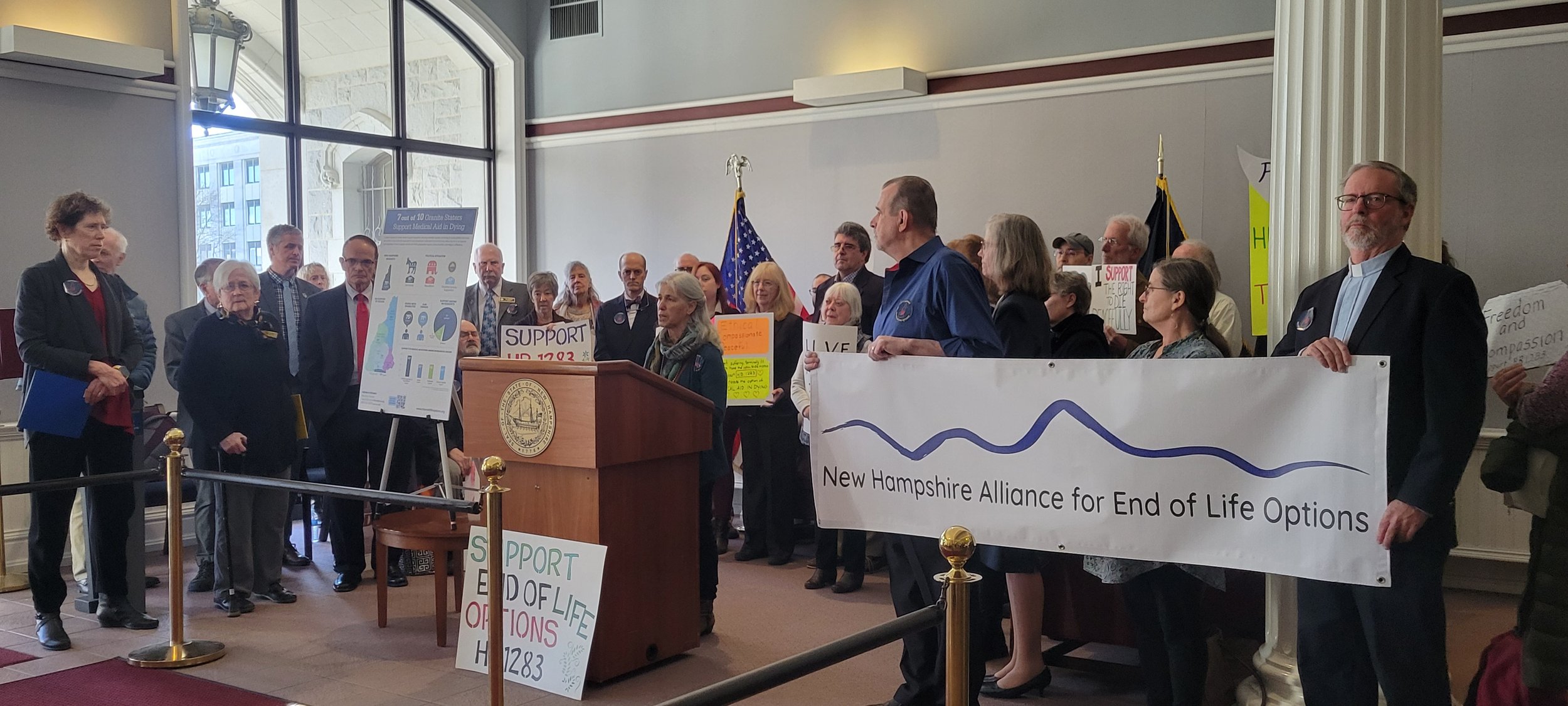
There has been legislative interest in medical aid in dying in New Hampshire for more than 15 years. In 2020, the New Hampshire Alliance for End of Life Options (NHAELO) became the first formal, strategic grassroots effort dedicated to bringing this option to our state. We believe that lasting social and policy change around death and dying requires a bottom-up movement and a bipartisan approach.
In 2024, NHAELO worked with legislative leaders Rep. Marjorie Smith (D-Durham) and Rep. Bob Lynn (R-Windham) to draft HB1283, the New Hampshire End of Life Options Act. With bipartisan support, the bill passed the New Hampshire House — a historic milestone. It marked not only a first for New Hampshire, but the first time a Republican-majority legislature in the United States passed a medical-aid-in-dying bill.
HB1283 was later sent to interim study by the Senate, a parliamentary procedure that avoids a vote on the bill itself. We were encouraged by the unexpected support of Sen. Keith Murphy (R-Bedford), who told his colleagues on the Senate floor that he would vote in favor of the bill. Like many supporters of medical aid in dying, his position was shaped by personal experience: he had recently witnessed the prolonged and painful death of a family member and hoped to spare others similar suffering.
Following the 2024 elections, NHAELO returned with a similar bill, HB254, the New Hampshire End of Life Freedom Act, introduced in January 2025 and again led by Reps. Lynn and Smith. The bill had bipartisan sponsorship and drew unprecedented public engagement. More than 2,200 New Hampshire residents signed a petition in support, joined by over 250 medical and mental health professionals and faith leaders. Despite this broad support, the bill was tabled in the House by a single vote.
After careful consideration, the Alliance decided not to reintroduce legislation in the second half (2026) of the legislative session. Instead, we are focusing on strengthening our coalition and reaching more people across New Hampshire — including clinicians, mental health professionals, older adults, veterans, and people living with disabilities. We are also working collaboratively with the state’s suicide prevention community.
We are firmly committed to suicide prevention. At the same time, many people are drawn to this movement because they have witnessed the suffering of terminally ill loved ones — including cases in which individuals, facing unbearable circumstances, took matters into their own hands. Characterizing medical aid in dying as suicide, as some opponents do, obscures these realities and does a disservice to terminally ill patients and their families. Medical aid in dying is a distinct, carefully regulated medical practice focused on autonomy, compassion, and the relief of suffering at the end of life.
Lynn/Smith op ed